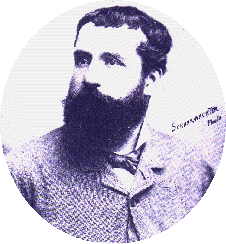
Portrait 	de Monet/Monet's picture
Claude Monet (1840-1926)

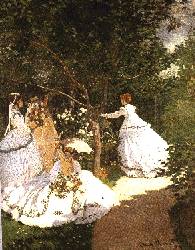
Monet used to paint landscapes and his paintings were often favourably received when they were shown at Salon. Highly influenced by Courbet and Manet, Monet started work, Women in the garden (Femmes au jardin) on a huge composition (255x205 cm) showing figures in the open air.
Thanks to Claude Monet and his painting "Soleil levant" in 1872, the School of the Impressionists

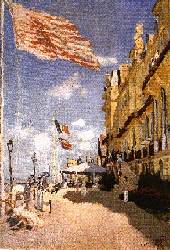
The Roches Noires Hotel at Trouville (L'hôtel des Roches Noires à Trouville) Monet's family lived in Normandy and he often painted there. He painted this picture at Trouville. That painting shows us fortunate people having a good time, the impression I get from this are gaety, hapiness of an upper-middle-class . Of course in the 1860s the Normandy coast wasn't overcrowded ! No doubt it was a windy day. He conjured up the seaside freshness of this promenade. I wonder if Monet himself was as fortunate as the sitters of his picture, probably he wasn't.

Femmes au jardin/Women in the Garden
Femmes au jardin
Women in the Garden
L'hôtel des Roches Noires à Trouville/The Roches Noires Hotel at Trouville
L'hôtel des Roches Noires à Trouville
The Roches Noires Hotel at Trouville
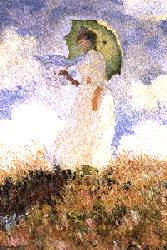
Femme à l'ombrelle tournée vers la gauche/Woman with a Parasol, Turned Towards the left
Femme à l'ombrelle/Woman with a Parasol

One of my favourite Monet's paintings surely is the "Woman with a Parasol, Turned Towards the Left" (Femme à l'ombrelle tournée vers la gauche). Figure in the open air, treated like landscape. He painted the picture from the point of view of an Impressionist landscape painter, he rendered the moment just as it presented itself to him. In this painting, Monet was so much struck by the impression the scene made on him that he has barely sketched in the face, and has thus depersonalized the model.

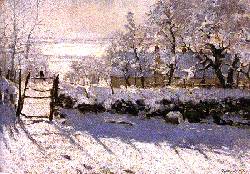
The Magpie (La pie) When I look at this painting I wonder how Monet's fingers withstanded the cold weather ? The secret for this is courage, passion, probably a little brasier, an easel, a couple of overcoats and gloves. The Magpie is one of the masterpieces of his early period.

La 	Pie/The Magpie
La Pie/The Magpie
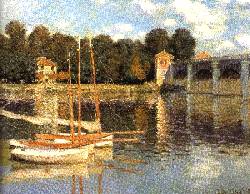
Le 	Pont à Argenteuil/The Bridge at Argenteuil
Le Pont à Argenteuil/The Bridge at Argenteuil

The Bridge at Argenteuil I know Argenteuil because I live near there and I would be delighted with such a view of that place, with what Monet could see when he painted this picture, he concentrated on representing the iridescent surface of the water and the landscape it reflects.

Monalisa
Back to the Museum